

The RFID Inventory and Location System brings order to the records of approximately 800 devices and items of furniture, and shows where equipment moved between treatment rooms is located.
The RFID Inventory and Location System brings order to the records of approximately 800 devices and items of furniture, and shows where equipment moved between treatment rooms is located.
Starting Point
Client: a multi-specialty children’s rehabilitation centre.
The centre supports the development of its youngest patients and assists their families. Valuable medical and therapy equipment is used every day by many specialists, who move it between treatment rooms. Asset counts were carried out by physical count or barcode scanning. The process took a long time and was error-prone, and establishing the current location and technical condition of devices required considerable effort. The management team was looking for a tool for fast, simple stocktaking and precise equipment location.
Challenges
- time-consuming physical counts and item-by-item barcode scanning,
- records that differed from the actual state of the assets,
- equipment moved from room to room and difficult to locate,
- the need for convenient checks of equipment condition and completeness.
Project Scope
| Area | Scope |
| Facility | children’s rehabilitation centre: treatment rooms and therapy rooms |
| Tagged assets | approx. 800 items: medical equipment, furniture, small fittings |
| Solution | RFID Inventory and Location System (SIL): a kit with the ISS NEO handheld reader, software, licence and a full set of tags |
| Technology | passive UHF RFID tags with a read range of up to 15 m |
| Data access | mobile and web applications |
Project Objectives
- simple, fast stocktaking of all assets,
- records that match the actual state of the assets,
- precise location of devices that change place,
- easy checks of equipment condition and the completeness of each room’s fittings.
Implementation
1. Pilot and Tag Selection
We began with a pilot at the facility. Testing in real conditions made it possible to match the tags and hardware to the types of items being tagged.
2. Asset Tagging
All medical devices, furniture and small fittings were fitted with RFID labels. Each item was entered into the database with a description, an assigned storage location and a photo that speeds up identification.
3. List-Based Stocktaking
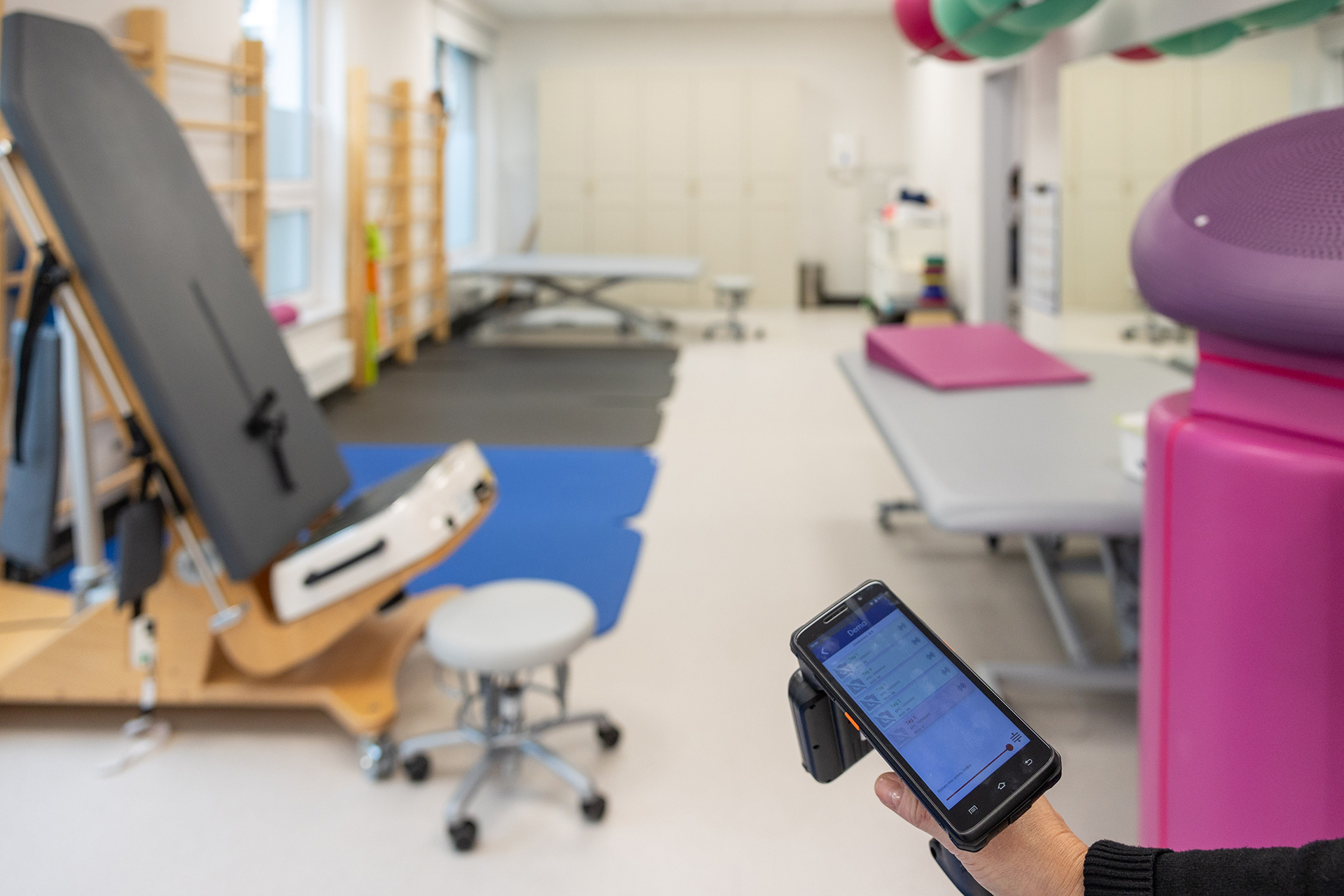
We prepared an equipment list for each room. Counts are carried out with a handheld reader that captures all labels within range simultaneously and compares the result with the list. Offline mode allows staff to work in areas with weak internet coverage as well.
4. Location and Radar
The system shows the assigned location of each item, and the radar function estimates its position based on signal strength (RSSI). The asset catalogue can be edited from the reader or in a web browser on a computer.
Results
Stocktaking at the facility now takes considerably less time, and the records accurately reflect the status of equipment and furniture. Specialists can locate equipment moved to other treatment rooms straight away, work in more comfortable conditions and devote more time to their young patients. Staff rate the solution as simple and intuitive to use.
Client Benefits
- Orderly rooms: fittings completeness checked against lists and photos.
- Fast stocktaking: many labels read at once instead of item-by-item counting.
- Reliable records: data that matches the actual state of the assets.
- Devices easy to find: assigned locations and a radar that indicates position.