


An RFID system for inventory of fixed assets and IT equipment in 50 stores and 3 warehouses across Poland.
Starting point
Client: a retail company operating 50 stores and 3 warehouses across Poland.
Traditional methods of inventorying fixed assets (including cameras, routers, servers, and electronics) were insufficient and inaccurate. They caused errors in managing equipment records in stores and warehouses and, at times, tied up employees for long periods.
Identified needs
- using RFID technology to manage IT equipment and fixed assets in stores and warehouses,
- control of equipment entering and leaving the warehouse,
- periodic mobile inventory in stores,
- locating fixed assets.
Inventory scope
| Area | Scope |
|---|---|
| Stores | 50 stores, average area of 35 m² |
| Warehouses | 3 warehouses, each 150 m² in area |
| Equipment in a store | Approx. 50 items per store |
| Equipment in a warehouse | 200–300 items per warehouse |
Project goals
- improve the inventory of fixed assets,
- control stock levels,
- control the direction of item movement,
- create a record history showing which stores equipment was issued to and how many times,
- develop software tailored to the client’s needs (solution customization).
Process
1. Selecting hardware and RFID tags
RFID hardware was selected to deliver the project according to the client’s agreed requirements, together with RFID tags for the fixed assets chosen for tagging:
- 2 mobile RFID readers and 2 fixed readers with a built-in antenna,
- RFID tags for marking equipment,
- proprietary ISS RFID software for managing data and reads.
2. Developing software with the required functionality
- inventory process using a mobile application, which also works offline,
- report generation, preview of stock levels and equipment locations,
- radar function in the mobile reader for locating individual items,
- access to the web application through a web browser,
- preview of stock levels in both warehouse locations,
- creating an equipment list for a given location based on items scanned with the integrated fixed reader,
- assembling equipment for a given location based on a specified list,
- import/export of data to/from the database using an MS Excel file.
3. Implementing the inventory process
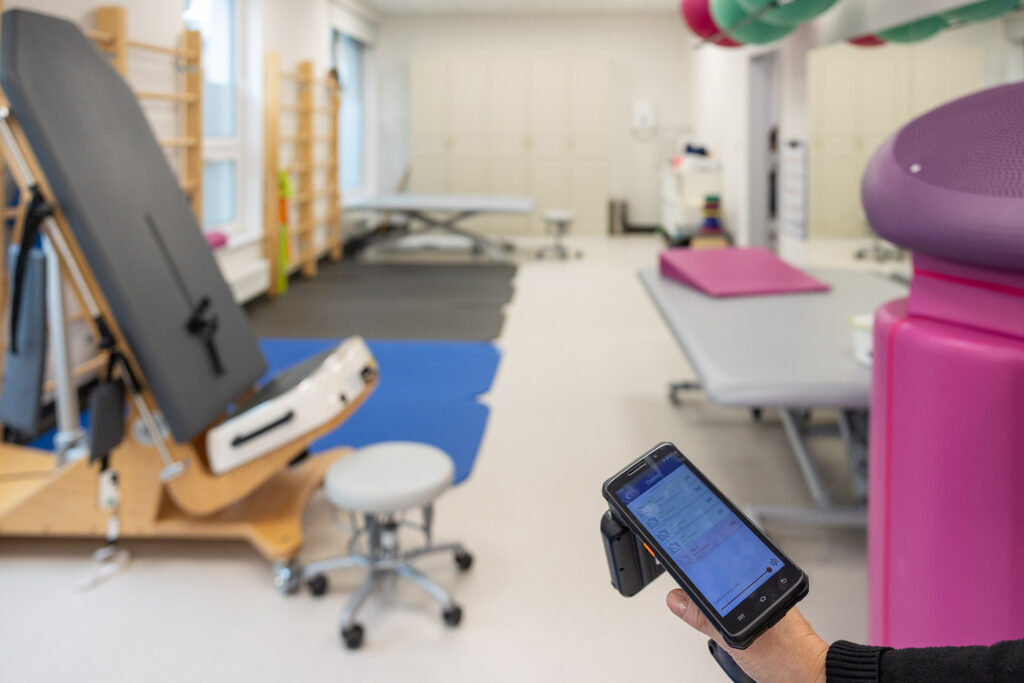
Inventory based on a specified list is carried out by employees using mobile readers.
Inventory could also be performed without internet access (offline mode), with data synchronized once the connection was restored.
4. Implementing the equipment issue and receipt process
Fixed readers are used to verify and distinguish the direction of equipment leaving and entering the warehouses.
Equipment is assigned to store locations, and removed from them, via the web application.
Result
Implementing RFID technology brought significant benefits in managing the client’s fixed assets in stores and warehouses, improving operational efficiency and enabling better control over resources.
The client gained a modern solution that automates the inventory of fixed assets.
Expected benefits
- Increased efficiency – faster and more accurate equipment inventory.
- Error reduction – lower risk of errors when assigning equipment to locations and when taking inventory.
- Better control – ability to monitor stock levels and the usage history of fixed assets on an ongoing basis.