

From WWII radar systems to modern automation platforms
Although radio technology may seem relatively new, the history of RFID dates back to the 1940s. Today it is widely used across logistics, manufacturing, retail, transportation and healthcare – and its potential continues to grow. How was radio-frequency identification invented, how has it evolved over the decades, and why is it now a foundation of modern automation?
1948 – Theoretical foundations of RFID
The starting point for RFID is considered to be the scientific paper by Swedish-American researcher Harry Stockman, “Communication by Means of Reflected Power”, published in 1948 in Proceedings of the IRE. Stockman was the first to describe the concept of communication based on the reflection and modulation of a radio signal by a passive object – the very principle behind today’s passive RFID tags. He noted that practical implementation would require many more years of research.
1940s – The IFF system and the origins of radio identification
The first application resembling modern RFID appeared during World War II. To distinguish friendly aircraft from enemy machines, the British developed the IFF (Identification Friend or Foe) system, which used radio signals to identify “friendlies.” Although primitive compared to today’s solutions, it laid the groundwork for further development of remote object identification. Transponders based on similar principles are still used in both military and civilian aviation.
1973 – The first RFID patents
The year 1973 is considered a breakthrough for commercial RFID. Mario W. Cardullo received US Patent 3,713,148 for a passive transponder with rewritable memory – widely recognized as the first true patent of modern RFID. In the same year, Charles Walton, an entrepreneur from California, patented a passive transponder used for keyless door access – the precursor of today’s RFID-based access control systems.
At the same time, Los Alamos National Laboratory worked on using RFID to track trucks transporting nuclear materials. The concept was later adapted for livestock identification, giving rise to commercial animal-ID systems still used today.
1970s-1980s – From military and laboratory use to civilian applications
In the 1970s and 1980s, RFID began expanding beyond military applications into civilian environments. Early systems for livestock identification and access control emerged. Researchers also experimented with passive tags that do not require their own power source – still one of RFID’s most important characteristics.
This period also marked the first use of RFID in transportation infrastructure. Norway became the first country to deploy RFID for automated toll collection. Similar systems appeared in the United States in 1989 on the Dallas North Turnpike, and soon after in the Lincoln Tunnel in New York.
1990s – Standardization and widespread adoption
The 1990s and early 2000s brought rapid development of RFID. Component miniaturization, lower production costs and technological progress opened the door to industrial-scale applications. By the late 1990s, more than three million RFID tags had been installed on railcars in North America – illustrating the scale achieved even before the era of the Internet of Things.
More companies began exploring automated identification of goods without manual scanning. RFID proved to be an ideal answer to the needs of logistics, warehousing and supply-chain management.
21st century – Miniaturization and the era of adhesive labels
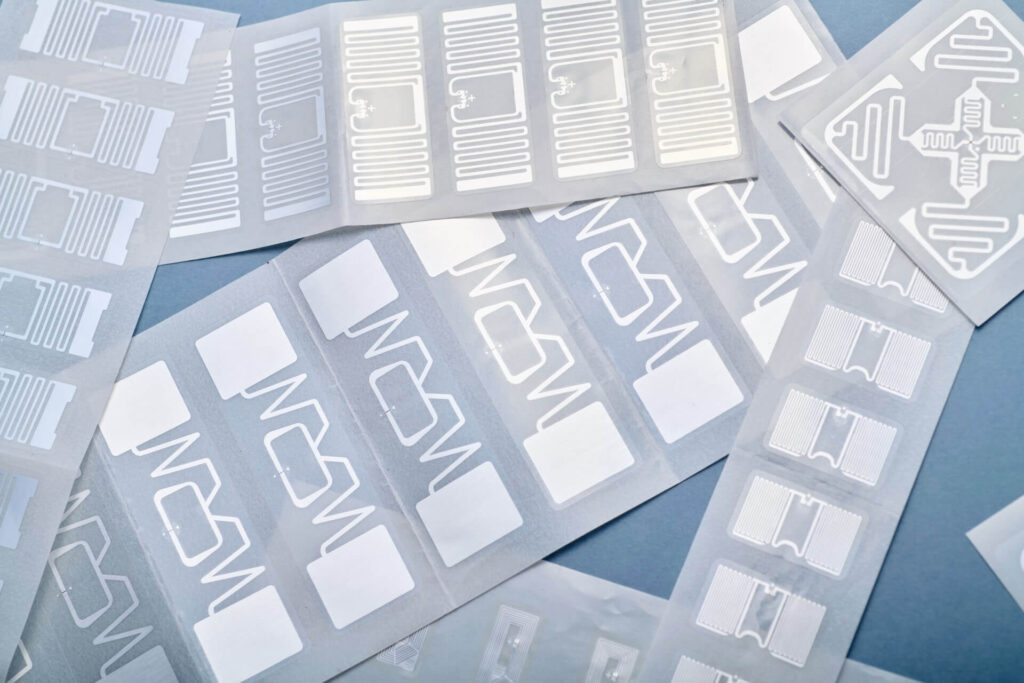
RFID was no longer reserved for specialized applications – it became accessible to a broader market, with more affordable deployment costs. In the early 21st century, RFID components were miniaturized enough to be produced as thin, self-adhesive labels that can be applied to almost any surface. As a result, RFID started playing a major role in operational processes across industries and became one of the foundations of the Internet of Things (IoT).
How RFID works
RFID (Radio-Frequency Identification) is based on data transmission using radio waves. A system consists of three core elements: an RFID tag, a reader and an IT system that processes the data. When a tag enters the reader’s electromagnetic field, information is transmitted – such as a serial number, production date, location or batch assignment.
Types of RFID tags
- Passive tags – no internal power source; they draw energy from the reader’s electromagnetic field.
- Active tags – have an internal battery and actively transmit signals, enabling long-range reads.
- Semi-passive tags – include a battery supporting the chip, but do not transmit signals independently; they still require activation by the reader.
RFID standards and frequency ranges
RFID systems operate under ISO standards defining communication protocols and use three main frequency bands:
- LF – ~125 kHz
- HF – 13.56 MHz
- UHF – 860-960 MHz
Read range depends on tag type and frequency – from a few centimeters for simple passive tags to 100 meters for advanced active tags in optimal conditions.
RFID should be distinguished from NFC (Near Field Communication) – a related HF technology limited to very short ranges (typically a few centimeters), making it suitable for contactless payments but impractical for warehouse operations requiring longer read distances.
RFID vs. barcodes
RFID enables contactless data capture, even through packaging, without the line-of-sight required for barcodes. It can read many tags simultaneously – hundreds per second – and works over longer distances. RFID tags store more data and are more resistant to physical damage. The trade-off is higher tag cost and greater investment required for system deployment compared to simple barcode scanners.
Advantages and limitations of RFID
Advantages:
- fast, contactless reading
- simultaneous reading of multiple tags
- higher durability compared to barcodes
Limitations:
- higher implementation cost
- multiple protocol standards on the market, sometimes causing compatibility issues between equipment from different vendors
Where RFID is used today
RFID is applied wherever fast, accurate and automated asset tracking is essential, including:
- logistics and warehousing – automated shipment tracking and inventory
- retail – stock monitoring, loss prevention, faster checkout
- healthcare – tracking medical equipment, monitoring pharmaceuticals
- transport and infrastructure – tolling systems, parking access, anti-theft solutions
- security – access control and movement monitoring
- archiving – document inventory in archives
- workforce management – time and attendance systems
RFID is also present in everyday life in forms many people do not associate with the technology – such as contactless payment cards and biometric passports.
RFID today – a foundation of digital process transformation
RFID is no longer just a supporting technology – it has become a cornerstone of digitalization, industrial development and intelligent warehouse operations. RFID data is increasingly valuable, enabling better decision-making, cost optimization and risk prediction.
Frequently Asked Questions
The theoretical foundations date back to Harry Stockman’s 1948 paper, and the first modern passive transponder patent was granted to Mario Cardullo in 1973.
Harry Stockman is credited with the conceptual foundation (1948), while Mario Cardullo authored the first modern RFID patent (1973). In the same year, Charles Walton patented another RFID application – a passive transponder for keyless door access.
The British IFF system used radio signals to distinguish friendly aircraft from enemy machines and is considered a conceptual precursor to modern RFID.
NFC operates in the same HF band but is limited to very short ranges, making it suitable for payments rather than warehouse operations.
RFID does not require optical visibility, can read multiple tags simultaneously and works over longer distances, but is more expensive to implement.