


RFID (Radio-Frequency Identification) implementation brings companies numerous benefits: time savings, more accurate data, lower losses and better product availability. Many people encounter RFID every day in the proximity cards used for access control. In business, however, the greatest impact comes from UHF RFID: identification via radio waves in which the reader captures hundreds of objects in a fraction of a second.
This article is aimed at owners and managers of manufacturing, logistics and retail companies, including small and medium-sized enterprises, that are considering RFID implementation. We show which benefits are measurable, in which processes they appear and what they depend on. If you want to find out whether RFID is right for your business, you will also find the key advantages of the technology here, along with a way to get started quickly.
How Does UHF RFID Work and Where Do the Benefits Come From?
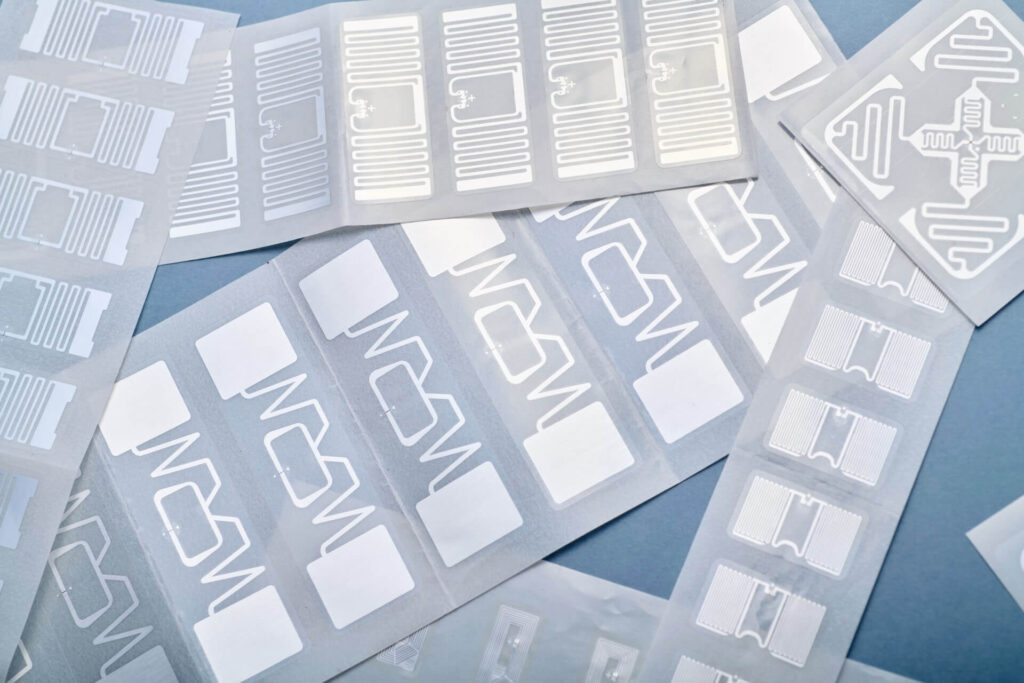
An RFID system consists of three elements: tags, readers with antennas, and software. A tag is an electronic circuit with an antenna that stores the object’s unique number. The reader’s RFID antennas emit a signal, and the tag responds with its identifier, contactlessly and without a direct line of sight.
RFID readers can operate in various frequency ranges. ISS RFID works in the UHF band with passive tags, which provide a read range of more than ten metres and capture many labels simultaneously. UHF waves carry the signal over longer distances than proximity cards, and their range makes it possible to cover an entire warehouse dock door.
The main difference between active and passive tags is the power source. Active tags have their own power source, while passive tags work without one, drawing energy from the radio waves emitted by the reader. This makes them cheap, lightweight and virtually maintenance-free, and they form the foundation of cost-effective implementations.
Faster and More Accurate Stocktaking
The main reason companies turn to RFID is faster stocktaking. The reader captures many tags at once, with no need to scan each item individually and without the optical line of sight that barcodes require. Counting a rack, a pallet or an entire room takes moments. A stocktake that traditional methods stretched over several days is completed many times faster and without stopping operations.
The benefit is especially noticeable for fixed assets, tools and equipment. More frequent counts stop being a burden, and missing items are easier to find thanks to signal strength indication.
SIL: An Off-the-Shelf RFID Stocktaking Package
A quick start is possible with the RFID Inventory and Location System (SIL) from ISS RFID. The package includes the ISS NEO handheld reader, proprietary software with a one-year licence, a set of UHF tags and online product training. The solution is available immediately and can be expanded later. It is a convenient route for companies that want to test the benefits of RFID in one area before extending the system to others.
Higher Inventory Data Accuracy
According to research by the RFID Lab at Auburn University and ECR Retail Loss, RFID implementation raises inventory record accuracy from approx. 60-70%, typical of traditional methods, to over 95%. Stock levels in the system match reality, and situations where a product is shown as available although it is physically missing occur far less often.
Accurate data enables efficient inventory management, production planning and smooth service for end customers. It is also key to on-time delivery: the order is fulfilled because the goods are actually there.
Reducing Human Error
Manual scanning and data entry invite mistakes: a misread, a missed item, a typo. RFID removes this intermediate step. Information enters the system automatically, so human errors at goods receiving, picking and dispatch occur less often.
A reader at the portal confirms the contents of the pallet at every stage, and the system immediately flags any missing or surplus items.
Real-Time Goods Tracking
RFID provides visibility of goods throughout the supply chain, from raw material receiving, through the production of finished goods, to shipment to the customer. Portals and fixed readers record movement automatically, so goods are tracked in real time and the company knows where every pallet, container or batch is.
Asset and production monitoring covers every stage of the process, including returnable packaging, pallets and carriers circulating between sites. This makes it easier to reduce their losses and settle accounts with business partners.
Automating Warehouse and Production Processes
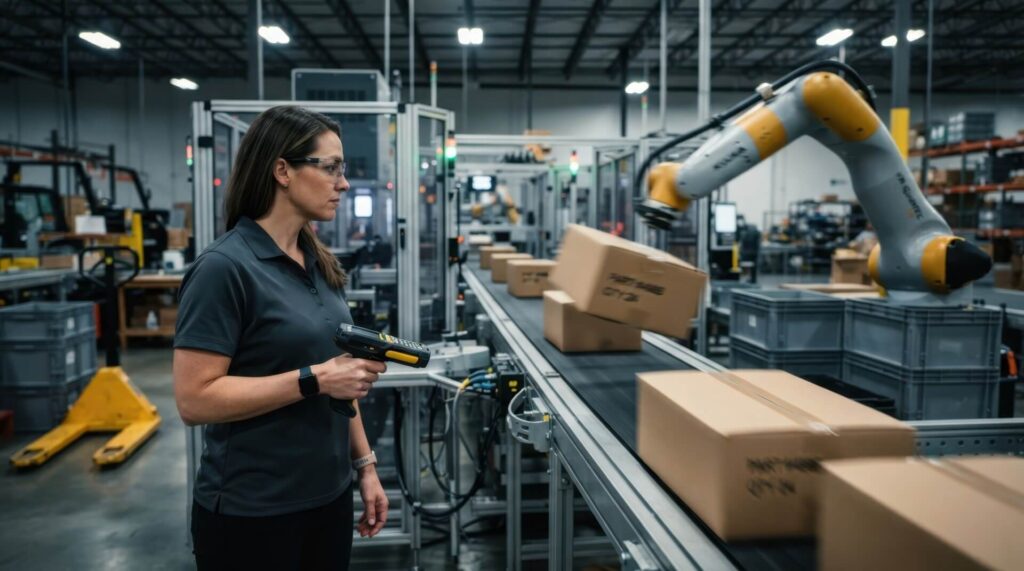
RFID automates warehouse and production processes: recording receipts and dispatches, picking verification, object location and tracking of production stages. On assembly lines, a tag on a carrier or component confirms that the part has reached the correct workstation, while logistics labels with a chip speed up shipment handling.
Pallets fitted with RFID labels pass through the portal without the forklift having to stop. The speed of the system translates into higher throughput of logistics processes, and employees can focus on tasks that require human decisions.
Reducing Losses and Protecting Assets
RFID reduces shrinkage, meaning losses from theft, operational errors or misplaced goods, in several ways. It makes shortages easier to detect, acts as a deterrent through exit gates and, at item level, shows exactly what went missing. Conventional anti-theft systems (EAS) only signal an attempt to remove goods.
Data protection is reinforced by access passwords and write locks in the tag memory, which prevent unauthorised devices from changing its content.
Higher Sales Through Product Availability
Accurate stock levels translate into sales: a product the system shows on the shelf is one the customer will actually find and buy. According to an ECR Retail Loss study, RFID implementation in retail is associated with a sales uplift of around 1.5-5.5%, depending on the product category and the scale of the project.
Better Planning and Inventory Optimisation
RFID, combined with the right software, makes it easier to plan deliveries, control minimum and maximum stock levels and forecast consumption. The system can flag batches with the shortest shelf life according to the FEFO principle (first expired, first out), reducing losses from expired stock.
Read data also feeds analytics, which increasingly relies on artificial intelligence to forecast demand. Accurate stock information supports sound purchasing decisions and effective inventory optimisation.
Integration with ERP and WMS Systems
RFID implementation builds on processes the company already knows. RFID systems integrate with existing software, such as SAP, another ERP or a WMS, and pass data automatically without manual re-entry. The team keeps working with familiar tools; what changes is primarily how the information is collected.
Saving Your Team’s Time
Beyond stocktaking, RFID shortens many small tasks that add up to real costs over the course of a year: searching for missing items, rescanning, and manually reconciling discrepancies between system and physical stock. The team can devote the time saved to customer service and business development.
Cost Reduction and Return on Investment
An RFID investment covers tags, readers, software, infrastructure and training. Cost reduction comes from process automation, fewer errors, lower losses and better control over assets. In the long run, the savings outweigh the cost of implementation.
An RFID process optimisation project is best started in the area where the most time is lost.
Examples of RFID Applications Across Industries
RFID has a very wide range of applications, and tags are used primarily in:
- Logistics and warehousing: receiving and dispatch through portals, picking verification, returnable packaging
- Manufacturing and automotive: tracking components and carriers at manufacturers and parts suppliers
- Retail and e-commerce: store inventory counts, order verification at packing
- Food industry: traceability of batches and reusable containers
- Fixed asset management: IT equipment and furnishings in offices, schools and public administration offices
- Healthcare: medical equipment monitoring
- Construction and field service: control of tools and equipment issued to employees
Advantages of RFID Technology
The main advantages of RFID are fast, contactless reading of many objects at once, process automation and more accurate data. RFID tags are also more resistant to dirt and damage than printed barcodes.
UHF technology also performs very well in demanding conditions. Dedicated tag designs are used on metal surfaces and liquid-filled containers, and tests in the client’s environment confirm read performance before implementation. With the support of an experienced partner, both large plants and small and medium-sized companies quickly feel the benefits of RFID.
Test Before Invest and ISS RFID After-Sales Support
An effective RFID implementation relies on the team’s specialist knowledge and experience. To make the benefits predictable, ISS RFID starts with a process analysis and tests on the client’s items, in the client’s environment, using the target tags and readers. The results show the actual read range and make it possible to estimate the results before investing.
After go-live, we provide after-sales support: technical assistance, servicing, supplies of further batches of tags, and expansion to new processes and sites.
RFID Benefits FAQ
The most frequently cited benefit is faster stocktaking combined with an increase in inventory data accuracy to over 95%.
According to an ECR Retail Loss study, RFID implementation in retail is associated with a sales uplift of 1.5-5.5%, mainly thanks to better on-shelf availability.
Item-level RFID shows exactly what went missing, whereas EAS systems only signal an attempt to remove goods.
RFID systems are integrated with existing software, such as SAP, ERP or WMS, and read data reaches them automatically.
Passive UHF RFID tags, selected for the surface: plastics, metal, liquid-filled containers and cardboard, and hard tags for harsh conditions.
The payback period depends on the scale and the process. It is fastest where RFID shortens stocktaking and reduces errors and losses.
With a process analysis and tests. The SIL package with the ISS NEO handheld reader enables a quick start.