


RFID Labels – Types, Applications and Pricing
RFID labels are one of the most commonly used data carriers in radio-frequency identification systems (RFID – Radio Frequency Identification). They combine small size, versatile application options and fast, contactless data reading using radio waves. Thanks to these features, they are widely used in logistics, warehousing, manufacturing, retail, healthcare and many other sectors.
What is an RFID Label Made Of?
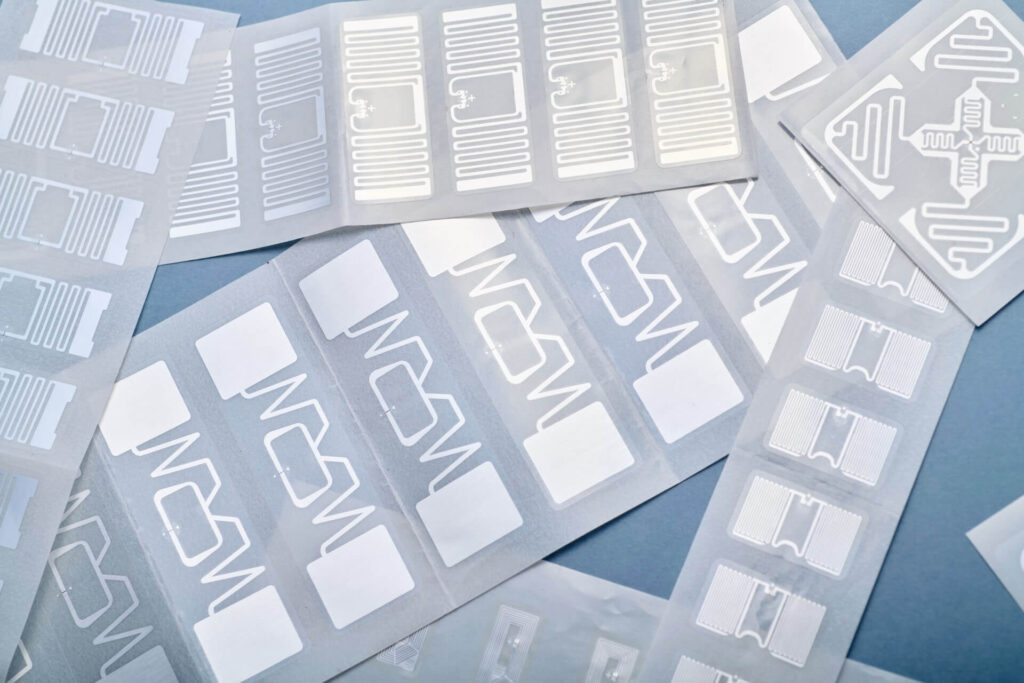
Although an RFID label may look like a traditional self-adhesive sticker, it is fundamentally different – it contains a miniature integrated circuit (chip) and an antenna, together forming an RFID inlay that enables wireless communication with a reader. The chip stores a unique identification number (often in the EPC – Electronic Product Code standard), while the antenna receives radio signals and transmits stored data.
Types of RFID Labels by Power Source
RFID labels fall into three main categories depending on how they are powered:
- Passive tags – no internal power source; they draw the energy needed for transmission directly from the radio waves emitted by the reader. This is the cheapest and most widely used type of label.
- Active tags – equipped with a built-in battery, allowing them to transmit signals independently over much longer distances.
- Semi-passive tags – have their own battery supporting the chip, but still require activation by the reader, similar to passive tags.
Labels for Metal and Non-Metal Surfaces
The wide variety of available solutions makes it possible to tailor RFID labels to almost any process – but technical and environmental factors must be considered. RFID labels differ in material (paper, film), temperature resistance, shape, size and antenna type, which affects read range.
Different labels are used on non-metal surfaces and metal surfaces. For metal applications, additional components such as an isolating layer (e.g., foam) are used to separate the chip and antenna from the metal substrate and prevent read interference caused by radio-wave reflection. Interference may also occur in environments with large amounts of liquid, so selecting the right label for the working environment is crucial for system reliability.
Labels designed for marking cardboard boxes in a dry warehouse will differ from those intended for areas exposed to mechanical abrasion or signal interference. The entire construction matters – top layer, mounting method, operating environment, and whether the label is intended for single-use or multiple cycles.
Why RFID Outperforms Barcodes
The key advantage of RFID labels over traditional barcodes is that data reading does not require line-of-sight or manual positioning of the item relative to the scanner. A single RFID reader can read many labels simultaneously, in a fraction of a second, whereas barcodes must be scanned one by one.
Additionally, RFID labels can store dynamic data updated in real time, not just a static, pre-encoded number.
Where Are RFID Labels Used?
RFID labels are used wherever fast, repeatable and automated identification of assets is required:
- Logistics and warehousing – tracking goods flow, speeding up inventory, real-time location tracking of shipments and logistics containers
- Manufacturing – component identification, process monitoring, asset and equipment tracking
- Retail – faster inventory, improved customer service, loss prevention and quicker theft detection
- Healthcare and administration – marking and monitoring medical equipment, document management
- Returnable packaging – circulation tracking
- Tool management – tracking issuing, returning and movement of equipment
- Fleet management – vehicle identification supporting fleet operations
RFID labels improve data accuracy, save time and reduce human error – regardless of industry.
Ready-Made Labels or On-Demand Printing?
Depending on company needs, there are two approaches to preparing RFID labels:
- Purchasing blank labels for on-site printing and encoding – flexible, but requires investment in an RFID printer and materials.
- Ordering ready-printed and pre-encoded labels – containing serial numbers, barcodes, graphics or logos.
ISS RFID provides such services using modern thermal-transfer printing and UV laser technology, ensuring durable markings and short lead times – often just a few days.
How Much Does an RFID Label Cost?
The price of an RFID label depends primarily on its power type and construction:
- Basic passive UHF labels – from approx. 0.15-0.50 PLN per piece for bulk orders
- Standard passive tags – from several dozen groszy to a few PLN per piece
- Hard tags (rugged tags) – from a few to several PLN per piece
- Semi-passive tags – typically several to a dozen PLN per piece
- Specialized active tags with batteries – from several dozen to several hundred PLN per piece
Label pricing often arises early in the planning phase, but it should not be viewed solely through the lens of unit cost. Final pricing depends on many factors – material type, durability, read range, and personalization needs.
A well-selected tag directly improves process efficiency, and long-term savings from automation outweigh the cost of the labels themselves – fewer errors, faster operations and better asset control.
Frequently Asked Questions
Passive tags have no internal power source and draw energy from the reader’s signal. Active tags have a built-in battery and can transmit signals over much longer distances.
It depends on frequency – LF and HF labels have ranges of a few to several dozen centimeters, while UHF labels can be read from several meters, and in favorable warehouse conditions even over a dozen meters.
Basic passive UHF labels cost approx. 0.15-0.50 PLN in bulk, hard tags cost several to a dozen PLN, and specialized active tags range from several dozen to several hundred PLN per piece.
Yes – provided that labels designed specifically for metal are used, equipped with an isolating layer separating the chip and antenna from the metal.
Yes. ISS RFID prepares labels with printed and encoded content – such as serial numbers, barcodes, graphics or logos – using thermal-transfer and UV laser technology.
If you want to choose RFID labels tailored to your industry and working environment, contact us – we will prepare a dedicated offer. Leave your contact details – we will call back within 24 hours.