

Knowing what is where at any given moment is the foundation of an efficient business. Barcodes and RFID tags are both used to label and identify products and fixed assets, but they work in entirely different ways. Comparing the two technologies helps match the solution to the scale and pace of your processes.
How Do Barcodes Work?
A barcode is information encoded visually on a label, either as lines of varying width or, in two-dimensional codes, as a pattern of square modules. Barcodes identify products in retail and make it easier to manage stock levels, prices and product descriptions. In warehouses and factories, they support fixed asset records and production monitoring.
Modern barcodes have been part of the economy since the second half of the 20th century. The most widely used standard in retail is the EAN (European Article Number), now known as the GTIN within the global GS1 system.
To read a barcode, you need:
- a barcode scanner or reader,
- a legible print in good condition,
- a direct line of sight between the scanner and the label.
Types of Barcodes
There are one-dimensional codes, made up of bars and digits, and two-dimensional codes: stacked codes, DataMatrix, QR, MaxiCode and Aztec. QR codes, which link to websites or store contact details, are becoming increasingly popular.
How Does RFID Work?
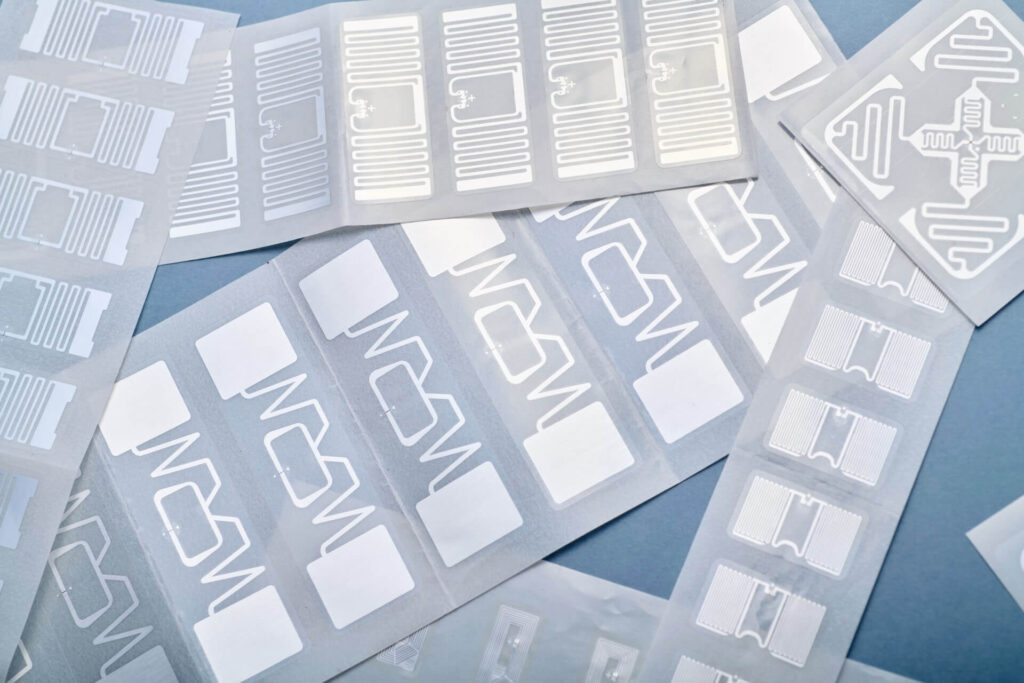
RFID (Radio-Frequency Identification) is a technology that uses radio waves to read and write information stored in RFID tags. Put simply, it is the radio equivalent of a barcode, with one key difference: the reader captures many tags at once, from a distance.
An RFID tag has its own memory, where data is stored in hexadecimal (HEX) format. This can be a unique number or converted text. For example, the string “7465787420696E206173636969” represents “text in ascii” in ASCII code.
Today, RFID is used across many industries: for goods tracking, fixed asset stocktaking, production oversight, tool records, and real-time location of products, packaging and logistics units. ISS RFID specialises in UHF technology with passive tags, which provides a read range of more than ten metres.
To read an RFID tag, you need:
- a working tag within the reader’s range,
- an RFID reader, either handheld (mobile) or fixed.
We describe the structure and operation of an RFID system in more detail in our article “What Is RFID Technology?”.
What Do Barcodes and RFID Have in Common?
Both technologies:
- make asset tracking easier,
- require a reader or scanner to capture data,
- store information that the system can easily process.
Key Differences Between RFID and Barcodes
Number of Simultaneous Reads
Barcodes are scanned one at a time, whereas an RFID reader captures many tags at once, in a few seconds and from a distance. Reading barcodes is like fishing with a rod: one catch at a time. Reading RFID is like casting a net that covers an entire pallet or rack.
Label Durability
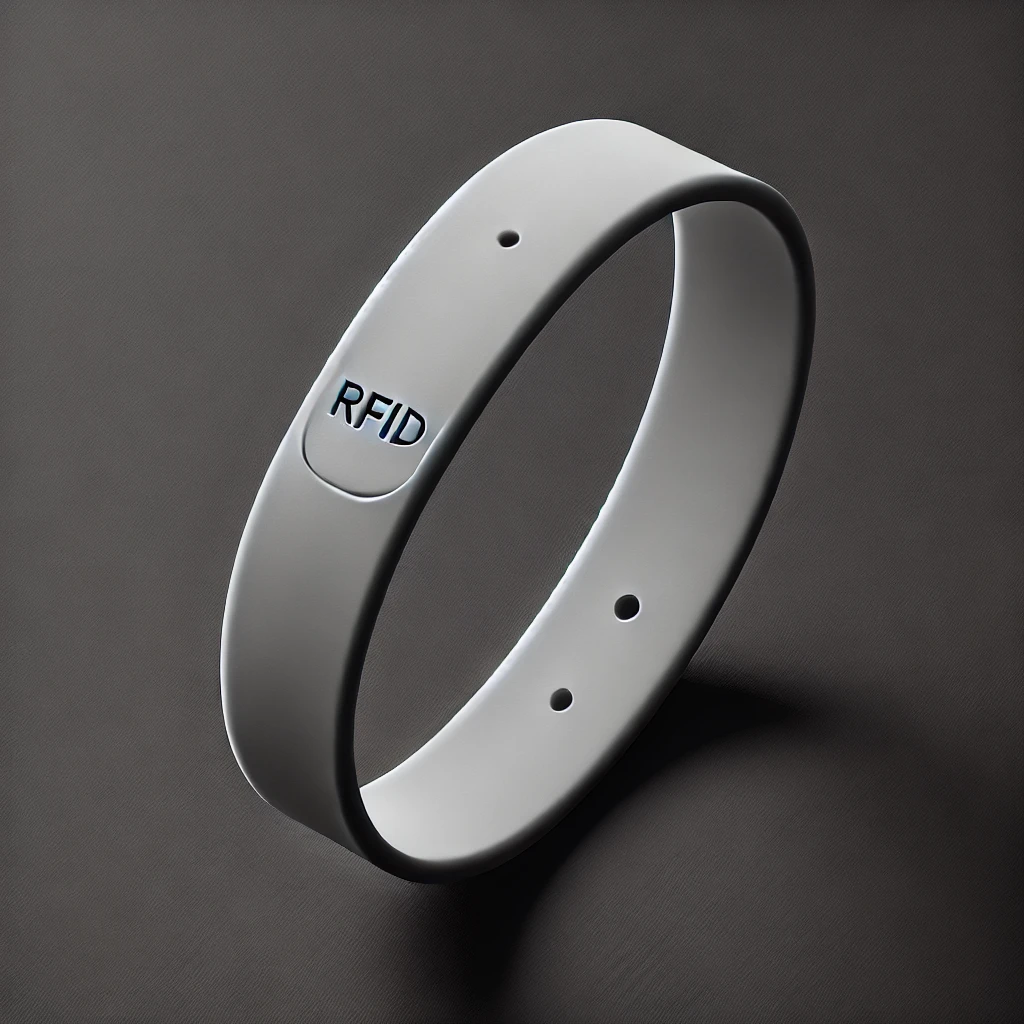
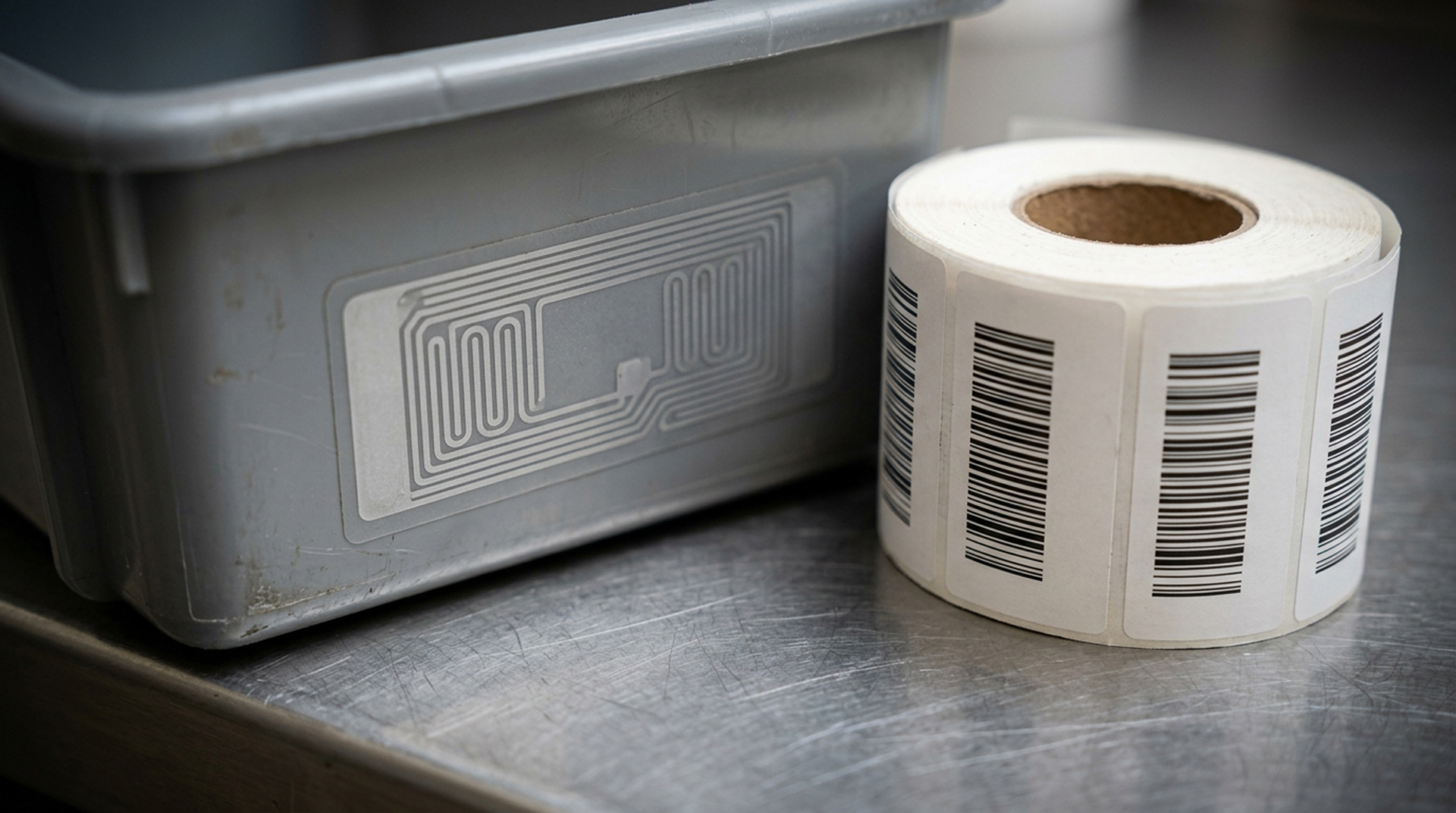
Barcodes are usually printed on paper labels, which are sensitive to dirt, moisture and abrasion. RFID tags typically take the form of plastic labels or rugged hard tags that withstand impact and harsh working conditions.
Reusability
The data in a barcode is fixed: changing it means printing a new label. An RFID tag can be re-encoded and reused many times, for example on returnable packaging or pallets.
Memory Capacity
The more data a barcode holds, the larger the print becomes. An RFID tag, even a very small one, stores information in its chip memory: up to several kilobits of data, depending on the model.
Cost and Return on Investment
RFID infrastructure (tags, readers and antennas) requires a higher upfront investment than barcode scanners, which are even built into smartphones. The investment pays back quickly: stocktaking takes less time, the team spends less time scanning, and stock data is more accurate.
Design and Implementation
A barcode system consists of a label and a scanner. An RFID system combines tags, readers, antennas and software, so it is worth entrusting its design to an experienced integrator. A well-designed RFID system works faster and more accurately, and the team can devote the time saved to more important tasks.
Advantages of RFID Technology
- Fast reading of many tags at once: up to several hundred tags per second and entire pallets in a single pass.
- Long-range reading: more than ten metres with passive UHF tags.
- Resistance to dirt and a longer label lifespan.
- The same tag can be re-encoded many times.
- Reading without line of sight: the tag can be hidden inside a plastic box or within a pallet.
- Text or a barcode can be printed on the RFID label, making it easy to combine both technologies.
- Dedicated tag designs for metal and liquid-filled containers.
When Is a Barcode Enough?
Barcodes work well where low labelling cost and simplicity matter: for selling individual products, in small warehouses, or in processes where goods are scanned item by item. As scale, pace or the need for automation grows, RFID gains the advantage. Both technologies can also be combined on a single label.
How to Choose an Identification Technology
Before deciding, it is worth answering a few questions:
- Which assets need to be tagged, and in what environment do they operate?
- What needs to be controlled or tracked?
- Which processes are worth automating, and how much time do they take today?
- What budget has been set aside for the project?
The answers, weighed against costs, the working environment and the company’s goals, point to the best solution. If you choose RFID, we guide you through the entire process: from analysis and a Proof of Concept test, through implementation, to ongoing maintenance. The off-the-shelf RFID Inventory and Location System (SIL) enables a quick start.
Choosing an identification technology for a specific process? We will help you select the solution best suited to your company.